Why the World Has Always Made Miniatures
Published June 4, 2026 by Anwen Thomas
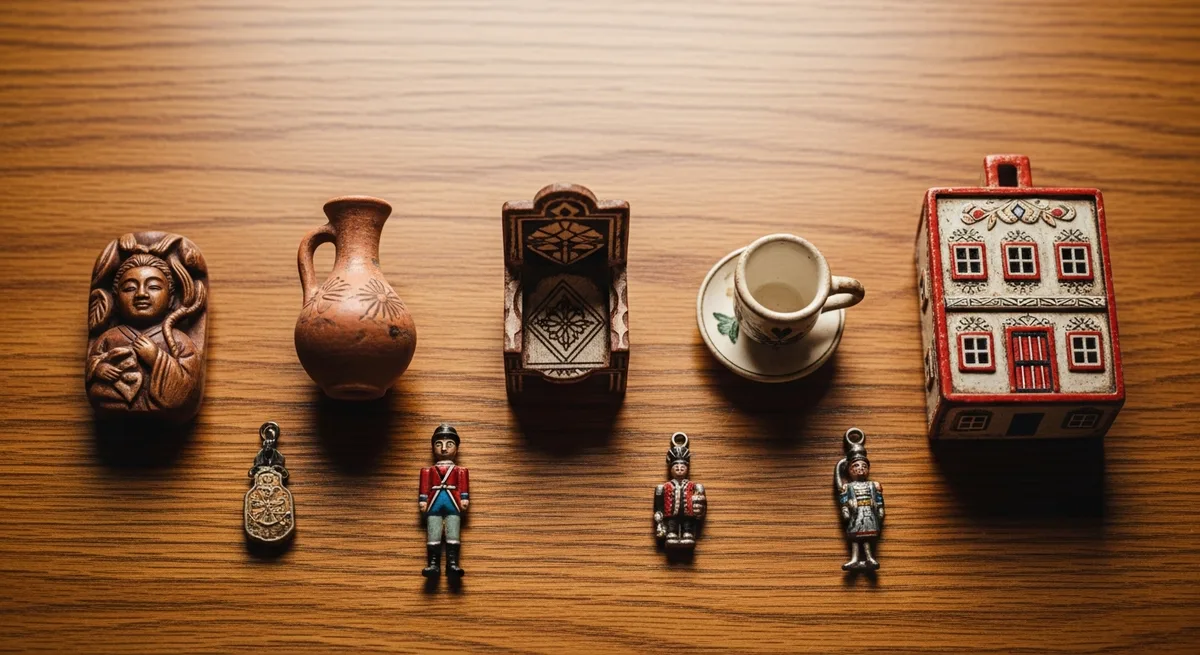
People have always made small things. Not just children, and not just for play. Look into the past of almost any culture and you will find tiny copies of real objects, made on purpose. A little clay pot. A small carved figure. A model of a house that fits in your hand.
What stands out is that this happened all over the world, in places that never met or shared ideas. That is unusual. Most art forms spread from one people to another. The miniature seems to have been invented many separate times. So it is worth asking a plain question. Why do we keep making the world small?
Small worlds for the dead
Some of the oldest miniatures we have were made for the afterlife.
The ancient Egyptians filled their tombs with small wooden models. There were model boats with model rowers. There were tiny bakeries and breweries, with little workers grinding grain and shaping bread. The point was to keep these scenes going for the dead person forever. Researchers who study the models argue they were a way of thinking, a bit like writing in three dimensions. By building a small version of daily life, Egyptians could lay out and pass on how their world worked (Cambridge Archaeological Journal).
China did much the same thing. In tombs from the Han dynasty, families placed clay models called mingqi, which means "spirit goods." Archaeologists have dug up small farmhouses, towers, wells, and animal pens. These were not toys. They were meant to give the dead a full and comfortable life underground (Journal of Chinese Religions).
Two cultures, far apart, reached for the same idea. When they faced the largest thing they could imagine, which was death, they answered it with something small.
The same object can be art or a toy
Here is what makes the miniature strange. The same kind of object can be a treasure and a plaything.
Take Japanese netsuke. A netsuke is a small carved button, often no bigger than a thumb. People used it to hang a pouch from a sash. Over time, carvers turned these little buttons into true works of art. Today museums show them behind glass.
Now think of the dollhouse. We treat it as a child's toy. But the first famous ones were not for children at all. In the Dutch Golden Age, wealthy women built "cabinet houses" filled with real silver, glass, and tiny paintings made by skilled craftworkers. One could cost about as much as a real house. They were status symbols and serious collections, kept by adults (Arts).
So the miniature lives a double life. It sits in a museum, and it sits on a bedroom floor. Very few objects do both.
What small things do to the mind
There may be a real reason miniatures pull at us. They seem to change how we pay attention.
In 1981, a researcher named Alton DeLong ran a simple test. He had people sit with scale models of rooms and imagine living inside them. Then he asked them to say when a set amount of time had passed. People in the smaller worlds felt time speed up. The smaller the model, the faster their inner clock seemed to run (DeLong, 1981, Science). A few years later, other researchers ran the test again and found the same effect (Mitchell & Davis, 1987, Perception).
Think about what that means. When you lean over a tiny world, part of your mind steps inside it. You lose track of the clock. The full-size world, with all its noise and worry, goes quiet for a while.
That may be the heart of it. A miniature is a world you can hold. You decide where every chair goes. You can take all of it in at once, which you can never do with the real world. For a child, that is the first taste of being in charge of something. For an adult, it can feel like rest.
The same habit, still going
This is not only old history. The same habit is alive right now. It just keeps changing its clothes.
People build model train layouts in their basements. They paint tiny soldiers for tabletop games. They film working stoves the size of a coin. They hunt for small copies of real grocery items sold in plastic capsules. These look like different hobbies. Underneath, they are the same old move. Take the world, shrink it, and make it yours.
That is what this whole site is about. The museums, shows, clubs, and shops we map are all places where people answer that pull. The miniature is not a passing trend. It is one of the few things that almost everyone, everywhere, has felt the need to make.
You can find the people doing it near you in our directory. If you want to start your own small world, our beginner's guide is a good place to begin.
Sources
- DeLong, A. J. (1981). "Phenomenological Space-Time: Toward an Experiential Relativity." Science, 213(4508), 681–683. science.org
- Mitchell, C. T., & Davis, R. (1987). "The Perception of Time in Scale Model Environments." Perception, 16(1), 5–16. journals.sagepub.com
- "Building Ideas out of Wood: What Ancient Egyptian Funerary 'Models' Tell Us about Thought and Communication." Cambridge Archaeological Journal. cambridge.org
- "Mechanism of Life for the Netherworld: Transformations of Mingqi in Middle-Period China." Journal of Chinese Religions, 43(2). tandfonline.com
- "The Material Culture of Seventeenth- and Eighteenth-Century Dutch Dollhouses: Replication, Reproduction & Imitation." Arts, 14(6), 151. mdpi.com